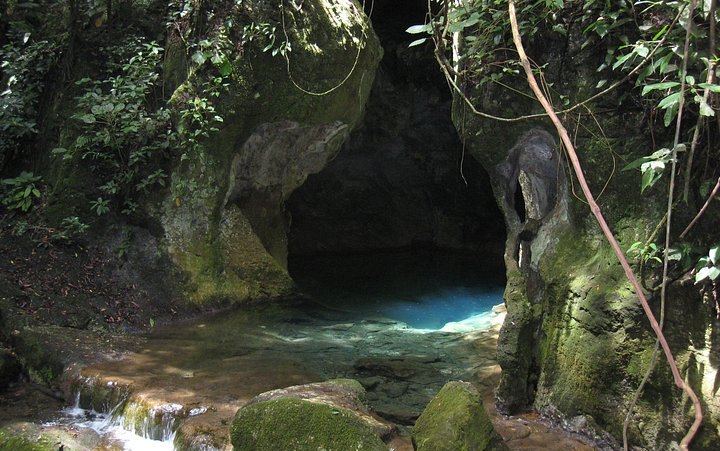
In shortSwimming is part of the day, but only briefly. The way in is a spring-fed pool at the limestone mouth, crossed in 10 to 15 seconds by one licensed operator's timing, wearing a helmet and life jacket. Inside, about 90 minutes goes on wading no deeper than chest height. Non-swimmers do take part, with the supplied life jacket and a guide alongside in groups capped at six per certified guide.
10-15 secondsswim at the cave mouth
Ankle to chestwading depth inside
78°Fconstant water temperature
6 guestsper certified guide
The water on the route, stage by stage
Water arrives in three separate ways, and they are nothing like each other. On the walk in from the vehicle, roughly 45 minutes of flat jungle trail through Tapir Mountain Nature Reserve by the Belize Tourism Board's description, you ford the stream three times on one licensed operator's count. The first of those fords sits somewhere between knee and waist depth and has a rope fixed across it to steady yourself on. These are standing crossings, done in your shoes, with the group together.
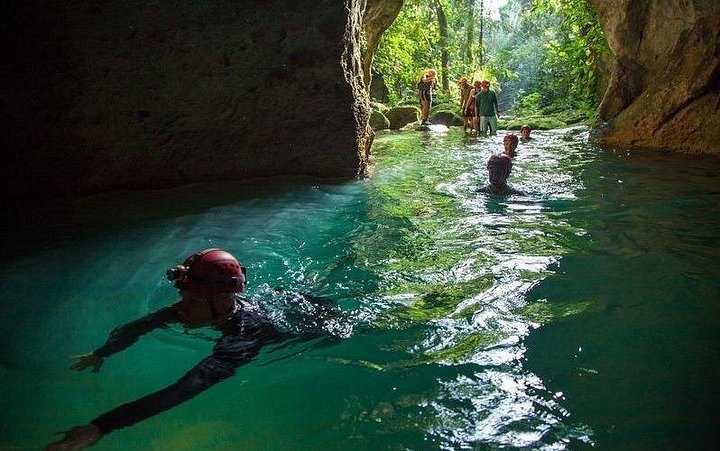
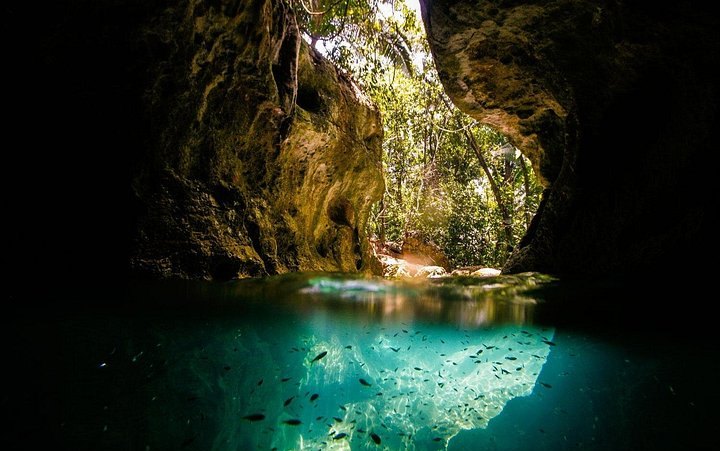
The second is the entrance. The Belize Tourism Board lists a short swim into the cave mouth as part of the trip, and one licensed San Ignacio operator times that crossing of the small spring-fed pool at 10 to 15 seconds, with life jackets provided; another measures it at about 20 feet. Helmet on, life jacket on, a few strokes or a float across, and your feet find rock again.
The third is the river passage itself. One operator's account of the underground stretch gives roughly 90 minutes of wading no deeper than chest height, plus swimming through some narrow passages and climbs over rock obstacles including a waterfall step. Another describes the wading as ranging from ankle to chest. The whole thing ends out of the water: a 12-foot ladder up to the dry archaeological level, taken one person at a time with hands and feet on the rungs.
Where swimming is required on the ATM cave tour
There is no dry way in. The pool at the limestone mouth is the only entrance used by visiting groups, so everyone who sees the chambers has crossed it. That crossing is short, measured in seconds rather than minutes, and it is done in a buoyancy aid. Inside the cave, some of the narrower sections are passed by swimming as well, according to one licensed operator's description of the route.
What is not required is technique, speed or distance. Nobody times your stroke and nobody swims a lap. If you can get into chest-deep water without panicking, hold a rope or a guide's arm, and let a life jacket hold your head up for a quarter of a minute, the water is not what will decide your day. Fitness and nerve matter more: one licensed operator rates the tour's difficulty 4 out of 5, with about 3 hours underground inside a total day of 8 to 9 hours.
The standard San Ignacio full day
Buoyancy for the pool is part of the kit on this 9-hour departure: life jackets, plus helmet and headlamps, the specially licensed guide, a three-hour walk through the cave system and lunch with a drink. From $145 per person, ★ 5.0 (1507 reviews).
★ 5.0/5 · 1,507 reviews
Depth, temperature and how long you are in it
Depth changes with the riverbed rather than following a fixed line, which is why guides keep the group close through the wading sections. The figures below come from licensed operators and from the Belize Tourism Board; check conditions on the day, because river levels move with the rain.
- Water temperature holds at a constant 78°F, so cold is not the problem on a standard day.
- Quick-drying clothes and closed-toe shoes with grip handle the mud, the boulders and the crossings.
- Swimwear-style tops and sleeveless shirts are not permitted under the dress code one licensed operator publishes, and photo ID is required.
| Stage | What the water asks of you | Depth or duration |
|---|
| Hike in, roughly 45 minutes | Three stream crossings on foot, on one operator's count | First crossing knee to waist-high, rope fitted for support |
|---|
| Cave mouth | A swim across the spring-fed pool in helmet and life jacket | 10 to 15 seconds on one operator's timing, about 20 feet on another's measure |
|---|
| River passage | Wading, short swims through narrow passages, climbs over rock | Ankle to chest, no deeper than chest height, roughly 90 minutes |
|---|
| Exit from the river | A 12-foot ladder to the dry level, four points of contact | Out of the water from here, shoes off and socks on |
|---|
How the ATM cave tour for non-swimmers actually works
Life jackets come with the tour as standard equipment. The 9-hour San Ignacio departure on this site lists helmet, headlamps and life jackets among what it includes, and the private departure lists helmets, life jackets and headlamps as well. You put the jacket on before the pool and you cross it with the group around you.
The guide ratio is what makes this workable. Current practice is a maximum of six visitors per ATM-certified guide, with larger parties split between guides, so there is one trained person for a handful of people at the exact moment the water goes over your waist. Tell the operator when you book that someone in the party cannot swim. A guide who knows in advance will position himself at the pool for you instead of finding out at the mouth.
If you want more than a share of that attention, pay for the private departure. It runs 5 to 8 hours from $320 per person with the pace set around your group, which means the crossings, the pool and the ladder get as long as they need. It carries ★ 4.0 (4 reviews). For a confident wader who simply dislikes swimming, the standard full day at $145 per person is enough.
High water after rain changes the day
River level is the single variable that matters most to anyone nervous in water. High water shuts the cave outright: the stop on Sunday 18 October 2026 followed days of heavy rain that pushed levels up, and the Institute of Archaeology only let groups back in on the Monday morning, 19 October, with Barton Creek and Nohoch Che'en still closed. Closures like that are decided on the day itself, by the people at the site.
In the wet months, roughly May to November, rain and mud also make the approach roads to the reserve impassable, leaving Teakettle as the only reliable way in. The dry season from about December to April is the dependable window. Weather updates and closure advisories go out on NICH's social media pages, which its policy asks you to read before any site visit; with a swim in the plan, read them the night before and again over breakfast.
Put the cave on the earliest morning your Cayo nights allow, with a second morning left free behind it. A closure costs you nothing when you have another day in hand, and the water will be lower on the day the cave reopens than on the day it shut.
If you will not swim at all
There is no version of Actun Tunichil Muknal without the entrance pool, so if swimming is genuinely out, choose a different cave rather than hoping to opt out at the mouth. Barton Creek Cave, the other NICH cave reserve in Cayo, is the usual fallback; its official ticketing page sets the gate at 8:00 am to 5:00 pm daily, the last tour one and a half hours before closing, and no entry into the cave after 4:00 pm. Check status before you travel, since it was still closed on 19 October 2026 when ATM reopened.
Nohoch Che'en, the cave tubing site, is the other usual substitute and was also shut through that October closure. Both respond to the same rain that closes ATM, so the advice about keeping a spare morning applies to them too.
For anyone staying in the water-and-archaeology camp, the honest test is this: chest-deep water, a few seconds afloat in a life jacket, a 12-foot ladder and about 3 hours underground. Clear that in your head before you pay, because the pool comes 45 minutes' hike from the vehicle and there is no path around it.
Questions people ask
Does the tour supply the life jacket, or do I bring my own?
It is supplied. The 9-hour San Ignacio departure includes helmet, headlamps and life jackets in its equipment, and the private departure lists helmets, life jackets and headlamps too. You do not need to buy or carry buoyancy aids to Belize for this.
Can a child who cannot swim go in?
Height is the only admission rule NICH publishes, set at 40 inches. Age is left to the operators: one equates that height to about five years old, another prefers not to take under-12s, and NICH states neither figure. Judge it against the pool at the entrance, the chest-deep wading and about 3 hours underground, and book the private departure if you want the pace held back for a child.
Will I be cold after the swim?
At a constant 78°F the water is warm enough that chill rarely sets in, and you keep moving anyway, wading, climbing and walking. Quick-drying clothes are enough, and you can leave a dry change in the vehicle for the ride back. Remember that the dress code one licensed operator publishes rules out swimwear-style tops and sleeveless shirts.
What happens if I freeze at the entrance pool?
Tell the operator before you book that you cannot swim. Groups are capped at six visitors per ATM-certified guide, so the guide can stay with you through the crossing, but there is no dry bypass into the cave and no way to wait outside and rejoin the group. If the thought of a few seconds afloat is already a problem, choose a different cave instead.
Is the swim the hardest part of the day?
For most people it is not. The crossing lasts 10 to 15 seconds on one operator's timing, while the rest of the day is a 45-minute hike each way with stream crossings, roughly 90 minutes of wading and climbing, a 12-foot ladder and 8 to 9 hours door to door. One licensed operator rates the whole tour 4 out of 5 for difficulty.
Read also