In shortActun Tunichil Muknal is the Belize cave known for Maya ritual killing. The material on its floor belongs to a ritual sequence that NICH places in the Early Classic, A.D. 300-600, and the Maya name NICH records for the cave, Cave of the Stone Sepulcher, describes what the chambers still contain. The dry upper level holds ceramic vessels and sherds, ground stone, offerings set on natural rock formations, and 14 sets of human skeletal remains, all left where they were found.
A.D. 300-600Ritual use begins, per NICH
14Sets of human remains
350 m x 50 mMain hall, upper level
May 2012Cameras banned inside
What the Maya were doing in Actun Tunichil Muknal
The oldest offerings on the floor belong to the Early Classic Period, which the Institute of Archaeology dates to A.D. 300-600. The cave's Maya name is translated on the official NICH page as Cave of the Stone Sepulcher. Nothing down there was built. Ritual parties walked in carrying pots and grinding stones, and later in the sequence of use they carried the dead.
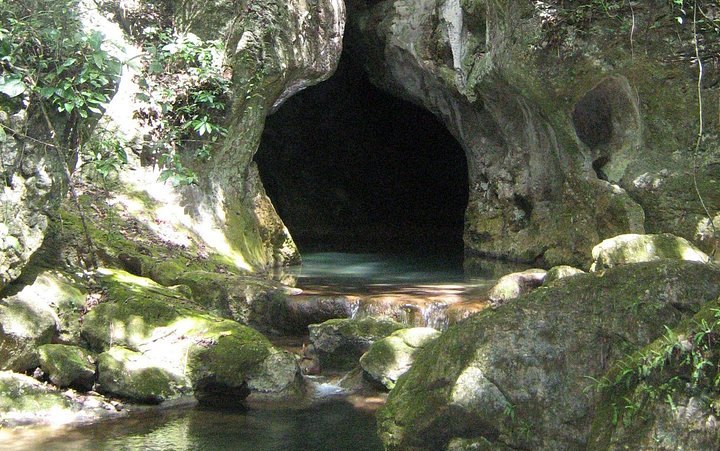
The geography explains why any of it survived. NICH gives the system as 3.13 miles long; surveyors describing the same passages put the main cave at about 3 miles (4.8 km), of which roughly 2 miles is river passage ending at a sump, with upper prehistoric passages running on about another mile through breakdown boulders and large rooms. Offerings went onto that upper, dry level, above the water that still moves through the lower passage.
Guides give a double interpretation. A cave with a river running out of it was a water source and an entrance to the underworld at the same time, a place where petitions for rain could be made directly, and the material deepens and gets grimmer in the later part of the sequence, which archaeologists read against a long run of drought years in the lowlands. That is interpretation rather than measurement, and a good guide will say so while pointing at the evidence it rests on.
ATM cave artifacts and pottery: what survives in the chambers
Ceramics dominate. Whole vessels stand where they were set down, and sherds lie in loose scatters, some of them half swallowed by calcite that has flowed over them in the centuries since. A number of the vessels have a hole punched through the base, which is read as taking the pot permanently out of household use, and your guide will usually crouch beside one and show you the break rather than describe it from a distance.
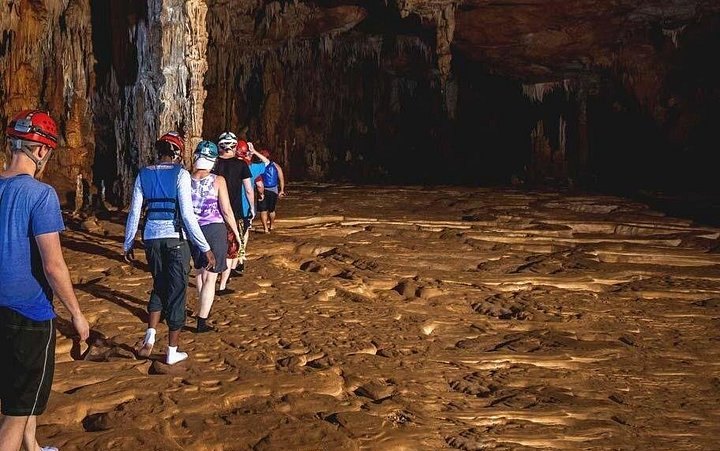
Ground stone turns up alongside the pottery: manos and metates, the everyday grinding equipment of a Maya kitchen, carried in over the streams and the river passage and left on the floor. Smaller offerings sit among the vessel groups. The deposit is spread across an upper level whose main hall is given as 350 metres long and 50 metres wide, so the material comes at you in clusters, with long stretches of bare rock in between.
Where a thing sits is part of the record. None of this was arranged for viewing; the groups were left in alcoves, on ledges and against formations, in chosen spots rather than convenient ones, and your guide will point out the pattern. Once you know that, the bare rock between the clusters starts to read as deliberate too.
| What you see | What it is | Where on the route |
|---|
| Whole ceramic vessels | Bowls and jars set down as offerings, several with the base deliberately pierced | Dry upper level, beyond the 12-foot ladder |
|---|
| Pottery sherds | Broken vessels in scatters, some cemented into the floor by calcite | Throughout the upper chambers |
|---|
| Ground stone | Manos and metates carried in and left with the vessel groups | Among the ceramic clusters |
|---|
| Stalagmites and flowstone | Natural formations used as settings and altars for offerings | Alcoves and ledges off the main hall |
|---|
| Human skeletal remains | 14 sets, the calcified Crystal Maiden among them | Deepest point of the visited route |
|---|
The standard day with a specially licensed guide
Three of its nine hours go to a walking tour of the cave system with a specially licensed guide, starting at the operator's San Ignacio office; helmet, headlamps, life jackets and a lunch with a drink are part of it, from $145 per person, ★ 5.0 (1507 reviews).
★ 5.0/5 · 1,507 reviews
The altars here are natural rock formations
No altar in this cave was built. Stalagmites, flowstone curtains and shelves of calcite were used as they stood, with offerings placed on, against or between them. Several formations have been modified only lightly, shaped or marked rather than constructed. Guides stop at a few of these and explain which part is natural and which part is human work, because at headlamp range the difference is not obvious.
The chamber that carries most of the material is the dry hall reached by a 12-foot ladder out of the river, climbed one at a time with all four points of contact; one licensed operator calls it The Cathedral. Light behaves oddly up there. The space is wide enough that your lamp does not reach the far wall, so the artifact clusters appear one at a time as the group moves.
Why it is called a Maya human sacrifice cave in Belize
The count on the dry upper level comes to 14 sets of human skeletal remains. They lie on the floor surface rather than in graves, and many are partly or wholly encased in calcite that has grown over them, which is how the best known of them acquired the name Crystal Maiden. A separate page on this site covers that skeleton and what is and is not known about it.
The reading of these deaths as ritual killing rests on where the bodies are and what surrounds them: deep inside a cave reached by water, on the same floor as the offering vessels, at the far end of a route nobody travelled casually. Skeletal injuries and the age range of the individuals feed into that interpretation. A guide who knows the literature will tell you that the ritual context is strongly established while the circumstances of each individual death are still argued over.
Chronology is part of the case as well. Ritual deposits in the cave begin in the Early Classic, A.D. 300-600 by the Institute of Archaeology's dating, and the human remains belong to the later stretch of that long use, when drought and political collapse were reshaping the lowlands. The history page on this site sets out the sequence and the 1989 discovery in order.
Nothing was taken to a museum, which is why the rules are strict
Everything described above is still in the cave. The pottery, the stone tools and the skeletons remain on the floor where they were left, in many cases locked into it by calcite, so the chamber is the find spot, the store and the exhibition at once. Lift a vessel out and the evidence of why it stood in that spot goes with it.
That is why the conduct rules here are tighter than at any Belizean site you can walk around. Footwear comes off before you step onto the dry level and socks are worn from there, so the floor takes a softer load. Movement follows one marked line of travel, with the guide ahead of you choosing where feet may land. Cameras and all other electronic devices are kept out by government rule, in force since May 2012 after a dropped camera damaged bone more than a thousand years old; people walk in with empty hands and the guide carries the only bag.
The access system works from the other direction. NICH requires every visitor to be on a guided tour arranged in advance with a licensed operator, tickets for this site are sold through those operators rather than on the official ticket store, and only a small licensed group of agents may take groups inside. Parties are kept to a maximum of six guests per ATM-certified guide, with larger bookings split across guides. NICH's one admission criterion is height, at least 40 inches. A modest dress code applies too: swimwear-style tops and sleeveless shirts are not permitted, and photo ID is required.
- Shoes off and socks on for the artifact chambers
- One marked route, with the guide setting the line past each cluster
- No cameras, phones or other devices inside, by government rule since May 2012
- Six guests per ATM-certified guide
- Guided entry only, booked in advance with a licensed operator
How to pick a tour that explains the chambers
Since you cannot read a label or take a photograph, the guide is the entire interpretive layer of this visit. Choose a departure that puts a specially licensed ATM guide with you for the full three hours underground, and ask what they know about the ceramics before you pay. The difference between a competent escort and someone who has worked with the archaeology shows up the moment you stand over a pierced vessel.
For most people the standard full day out of San Ignacio does the job, and it is the departure with by far the most reviews behind it. About 95% of tours into the cave start from that town, the Belize Tourism Board puts the drive from San Ignacio to the trailhead at roughly 45 minutes, and pickups fall early in the morning, so build the visit into a Cayo night rather than a coastal day trip.
Going private buys pace rather than access. The route, the group ratio and the time underground stay the same, so pay the premium only if you want to linger at the vessel groups and the remains without a six-person line behind you. The private option is listed at 5 to 8 hours and from $320 per person; helmets, life jackets and headlamps come with it, along with lunch, bottled water and an air-conditioned vehicle.
Questions people ask
Are the artifacts in ATM cave real, or replicas?
They are the original deposits, still on the floor of the dry upper level. Nothing has been lifted out and put in a case for visitors, and much of the material is partly cemented into the rock by calcite that has formed over it. That is also why the route is marked and why your guide dictates exactly where you step.
Can I touch the pottery or pick up a sherd?
No. You stay on the single line of travel the guide sets and keep your hands off everything, loose-looking fragments included, since those are part of the recorded deposit. Footwear comes off before the dry level and socks are compulsory from that point. Removing anything from the cave is out of the question.
Why are there no photographs of the ATM artifacts from inside?
A government rule has kept cameras and every other electronic device out of these chambers since May 2012, when a dropped camera damaged bone more than a thousand years old. Hands are empty at the entrance and the guide's dry bag is the only one that goes in. Leave phones, action cameras and smartwatches in the vehicle, and use your camera on the jungle walk instead.
Were all 14 individuals in the cave sacrificed?
The ritual context is well established: the bodies lie on the same dry floor as the offering vessels, deep inside a cave reached by water. The circumstances of each death are less settled, and specialists differ over individual cases. A guide who knows the material will separate what the deposit shows from what is inferred.
How much time do you actually spend among the artifacts?
Roughly three hours underground in total, inside a day of eight to nine hours door to door from San Ignacio. A large part of those three hours goes on the river passage and the climbs before the ladder, so the time on the archaeological floor is the quieter, slower end of the visit. A private departure is the way to stretch it.
Read also